
Books
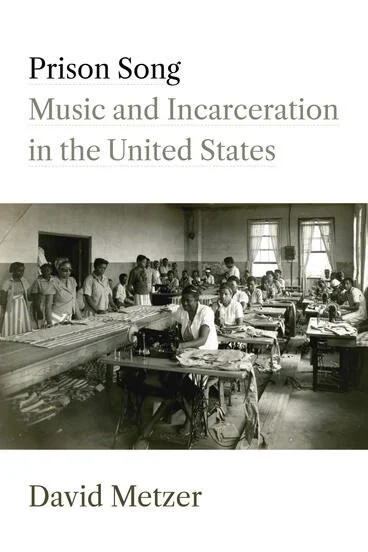
Prison Song: Music and Incarceration in the United States
University of Michigan Press, 2026
Over years of listening to Johnny Cash’s At Folsom Prison, Grandmaster Flash and the Furious Five’s “The Message,” and Joan Baez’s “Prison Trilogy,” I did not realize that I was listening to a particular history, nor did I anticipate that one day I would write that history. Those recordings are part of the long tradition of musicians confronting the prison system. They have challenged incarceration by telling the life stories of imprisoned individuals, creating empathetic bonds between listeners and those individuals, and critiquing the social and racial inequalities embedded in the prison system. The scope and boldness of these protests demand a broad history. Prison Song: Music and Incarceration in the United States offers such a history, one spanning the 20th and 21st centuries and a wide range of genres, including hip hop, country, blues, rock, classical, and jazz. The voices of incarcerated, formerly incarcerated, and nonincarcerated musicians from diverse racial and ethnic backgrounds ring throughout the book. The impact of these artists and songs forcefully emerges when they are placed side by side in a history of music and incarceration in American society. Prison Song is the first book to chronicle this history.
Buy the book (University of Michigan Press)
The Ballad in American Popular Music: From Elvis to Beyoncé
Cambridge University Press, 2017
I have been listening to and crying over ballads since I was a kid. It was only recently, though, that I asked why these songs touch all of us so deeply. The Ballad in American Popular Music: From Elvis to Beyoncé is my attempt to answer that question. The book also offers a history of the ballad, or histories. The first is a history of the songs, how they have changed over the years and the contributions of the celebrated singers associated with them, including Elvis, Beyoncé, Aretha Franklin, Barry Manilow, and Whitney Houston. The second history is one of emotions in popular culture, that is what ballads tell us about how feelings have been understood and experienced and how those experiences have changed over the seventy years covered in the book.
Read an excerpt: "Hip Hop Ballads"
Listen to "American Ballads: The Playlists" (Spotify)
Buy the book (Amazon)

Musical Modernism at the Turn of the Twenty-First Century
Cambridge University Press, 2009
“[A] thought-provoking read... written in an engaging and sometimes compelling style.”
– Musical Times
I have always enjoyed when historians turn away from the distant past and look at the present day. We can learn much about our world when viewing it from a historian’s perspective. That is what I have done with contemporary classical music in Musical Modernism at the Turn of the Twenty-First Century. As I argue, recent works continue inquiries into music, sound, and aesthetics that emerged in the modernist revolution at the turn of the last century. There are direct, intricate, and expanding links between music from around 1900 and 2000. It is a bold argument that demands that we revise our understanding of both contemporary music and modernism.
Buy the book

Quotation and Cultural Meaning in Twentieth-Century Music
Cambridge University Press, 2003
“[A] lucid, perceptive study... helped me to hear the music with new ears. There’s no higher praise for musical analysis.”
– Gramophone
Quotation is one of the fundamental practices of musical creation. It involves the use of bits of one work in a new piece, and it has been going on for centuries and across genres, from the grafting of chant melodies in medieval motets to sampling in hip hop. My book focuses on approaches to quotation in various styles of twentieth-century music. In particular, I consider how musicians quote songs with strong cultural associations and work those associations to address such larger topics as race, madness, childhood, and technology. The diverse cast of characters in the book includes Charles Ives, Duke Ellington, Arnold Schoenberg, Karlheinz Stockhausen, Janet Jackson, Public Enemy, and Sandra Bernhard.
Buy the book